
The Sweat–Detergent Reaction: Why Can Sweaty Skin Trigger a Flare-Up After Doing Laundry?
Clothes look clean, smell fresh, and feel soft. But when the body gets hot and sweaty again, some people actually start to feel itchy, irritated, or uncomfortable. Is the problem the sweat—or what’s still left in the fabric?A Hot Body, Cold Sweat, and an Unexpected Itch
“Imagine coming home after walking under the Surabaya sun. Your body is hot, you’re starting to sweat, and then you put on a T-shirt that’s just been washed. A few minutes later, your back and chest start to feel itchy.”
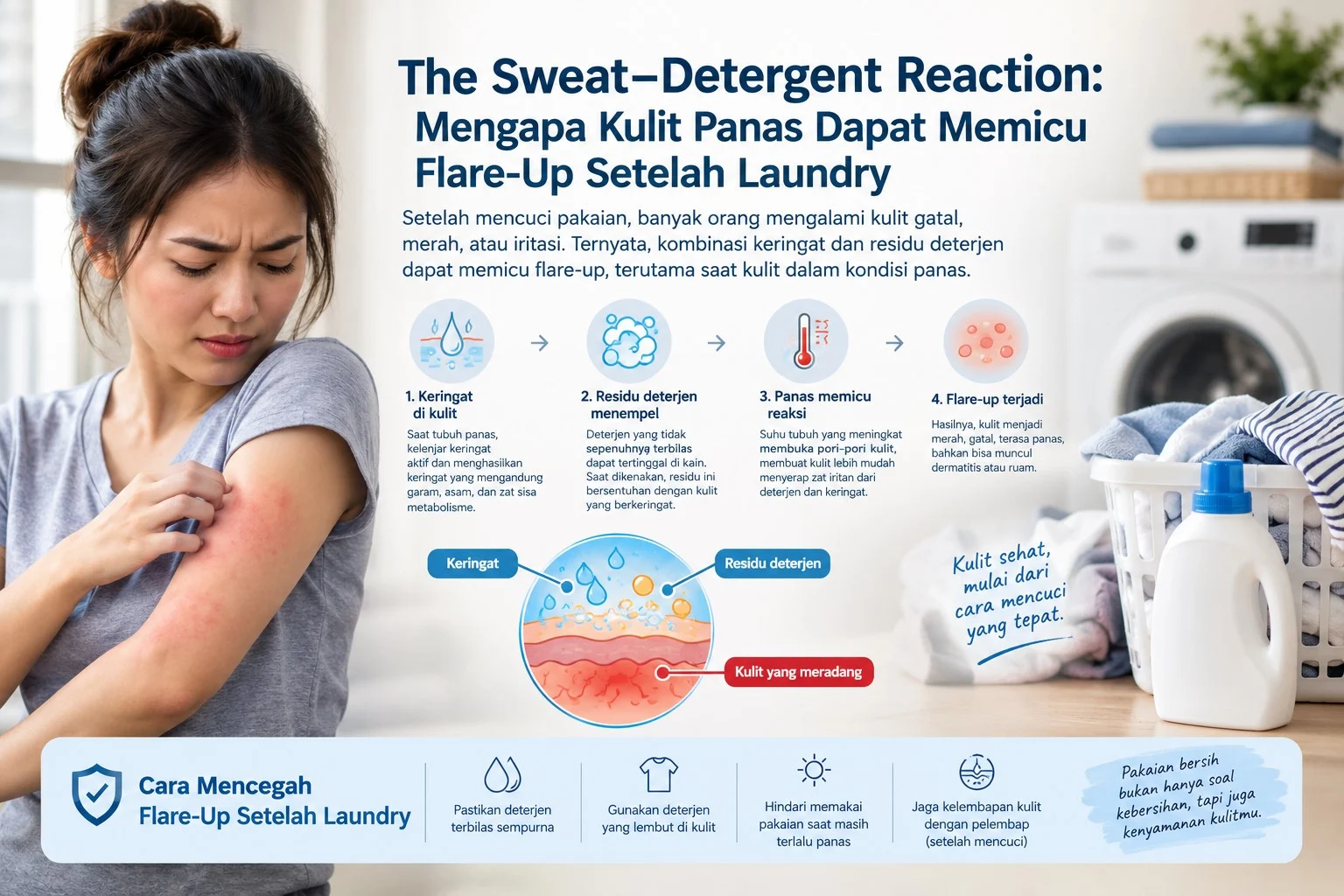
Many people immediately blame sweat. In reality, the relationship between sweat, heat, friction, the condition of the skin barrier, and clothing that comes into direct contact with the skin is far more complex.Heat and sweat can exacerbate certain forms of skin irritation. For sensitive individuals, clothing that still contains residues from the washing process may also be a factor worth investigating. The American Academy of Dermatology notes that detergents and bleach are among the irritants that can cause irritant contact dermatitis, while fragrances are also known to be a trigger for contact dermatitis.
Instead of Reading the Names of Ingredients, Let’s Read About “What They Do”
Economical detergent formulas are typically designed to achieve several goals at once: removing dirt, delivering effective cleaning performance, maintaining product stability, helping to counteract hard water, controlling appearance and scent, and remaining economical for regular use.
The Dirt Strippers
The “dirt-removal team” is responsible for loosening body oils, sweat, greasy stains, and dirt clinging to the fibers so they can be carried away by the water during the washing process.The Foam & Texture Team
This ingredient helps create the liquid’s texture and maintain the lather. However, more lather does not automatically mean cleaner clothes. In a washing machine, excessive lather can actually interfere with the mechanical process and the rinse cycle under certain conditions.The Hard Water Softener
These auxiliary components help bind minerals from the water so that the washing system can operate more consistently when water quality varies.The Deep-Cleaning Booster
Alkaline boosters help speed up the removal of oil and organic dirt. Their role is to assist the cleaning system, not simply to make the detergent feel “stronger.”The Oxygen Cleaning System
The active oxygen system helps remove some organic stains and odors under favorable washing conditions. The final result still depends on temperature, time, dosage, fabric type, and the degree of soiling.The Product Protection System
Preservatives keep the product stable during storage. This does not mean that the product automatically sterilizes the drum of the machine or the laundry.The Scent Lock
The fragrance-retention system helps maintain the scent on the fabric. However, a long-lasting scent should not be taken as proof that the clothing is free of dirt or microorganisms.What Actually Happens During One Engine Cycle?
Cost-Effective Per Cycle Is Not Always the Same as Efficient Per Cycle
Product price isn’t the only economic factor. When it comes to washing machines, we also need to consider the number of loads, rinsing requirements, time, water usage, machine load capacity, and the final condition of the fabrics.
| Parameters | Economical Formula with High Cleaning Power | Low-Residue Approach / Professional Wash |
|---|---|---|
| Product costs | Costs can be low if the dosage is correct and the product is efficient for the load size. | It can be higher per dose, but can be adjusted based on the type of fabric and the purpose of the process. |
| Foam | This needs to be monitored because high foam is not a direct indicator of cleaning power. | The primary goals are cleaning performance and rinse efficiency. |
| Residue | It depends heavily on the dose, load, water, and number of rinse cycles. | Focus on measured doses and proper rinsing procedures. |
| The smell of sweat | This can be addressed if the cleaning process is appropriate for the type of contamination. | A specific approach based on the source of the odor can be used, rather than simply adding perfume. |
| Activewear | Consideration should be given to residue, fiber type, and rinsing performance. | Can be processed using customized formulas and programs. |
| Process control | It depends heavily on the dosage and the machine's program. | This can be established as an SOP: dosage → temperature → time → mechanical action → rinse → inspection. |
Odor Problems Aren't Always Solved by Adding More Detergent
The odor of workout clothes often stems from a combination of sweat, body oils, product residue, moisture, and odor-causing compounds trapped in the fibers. Using too much detergent isn’t necessarily the solution.More detergent
More products can increase the solution load and the need for rinsing. If not followed by sufficient rinsing, residue problems may increase.More fragrance
Fragrances can temporarily mask odors, but masking odors is not the same as eliminating the source of contamination.Improved process
A more controlled approach takes into account the type of fabric, the level of soiling, the source of the odor, temperature, time, mechanical action, dosage, and rinsing.Why Do Clothes Feel Different When Your Body Starts to Sweat?
When the body gets hot, sweat makes the surface of clothing damp. Moisture, heat, and friction can make sensitive skin feel even more uncomfortable. DermNet also notes that heat, moisture, and sweat can be factors that worsen irritant dermatitis.Therefore, if someone experiences itching after wearing freshly laundered clothes, don’t immediately conclude that sweat “activates toxins” from the detergent.5 Ways to Reduce Residue After Machine Washing
Is Warm Water Always Better for Odors?
Not always. The wash temperature must be adjusted according to the fabric care label, the type of soiling, and the machine’s capabilities.For sportswear that can withstand higher temperatures, warm water can be part of a cleaning strategy. However, increasing the temperature is not a substitute for the correct detergent dosage, mechanical action, contact time, and rinsing.Foam, Residue, and the Washing Machine: Three Things That Are Often Overlooked
1. Excess Foam
Excess foam can alter the characteristics of the wash cycle and make rinsing more difficult. The machine doesn’t need as much foam as possible; it needs the right chemistry and mechanics.2. Residue Buildup
If there is too much product or the rinsing process is inadequate, residue may remain on the fabric, and some of it may accumulate in the machine.3. Machine Maintenance
The drum, drawer, seal, and filter also require maintenance in accordance with the manufacturer’s instructions. A clean machine helps ensure consistent laundry results.At a Professional Laundry Service, “Clean” Isn’t Just About Detergent
Here’s the key difference between simply doing laundry and setting up a laundry system.Soil Analysis
What exactly needs to be removed: oil, sweat, food stains, dust, odors, or a combination of all of them?Fabric Analysis
Cotton, polyester, microfiber, wool, silk, and technical fabrics do not always require the same approach.Process Control
Dosage, temperature, time, mechanical action, water level, and rinsing must be viewed as a single system.Final Inspection
After washing, check the scent, appearance, texture, stains, moisture, and any possible residue before returning the clothes.When Clean Clothes Actually Make Your Skin Itch
Don’t rush to switch detergents every time you experience itching. Try a simple process of elimination:Clean Is a Process, Not a Bottle
“Detergent lifts the dirt. Water washes it away. The machine provides mechanical action. The rinse removes any remaining residue. Drying completes the process.”
So, when comparing budget laundry services to professional laundry services, don’t just ask: “Which one is stronger?”A more useful question is: “Which one provides effective cleaning with controlled dosage, foam, water, time, temperature, and rinsing?” For consumers with sensitive skin, the final result isn’t just about clothes that look white and smell fresh. Comfort after wearing the clothes again is also part of the laundry experience.