
White Shirt Got Stained
White clothing mixed with colored clothing may experience discoloration. Any treatment must take into account the type of fiber and the fabric’s colorfastness.
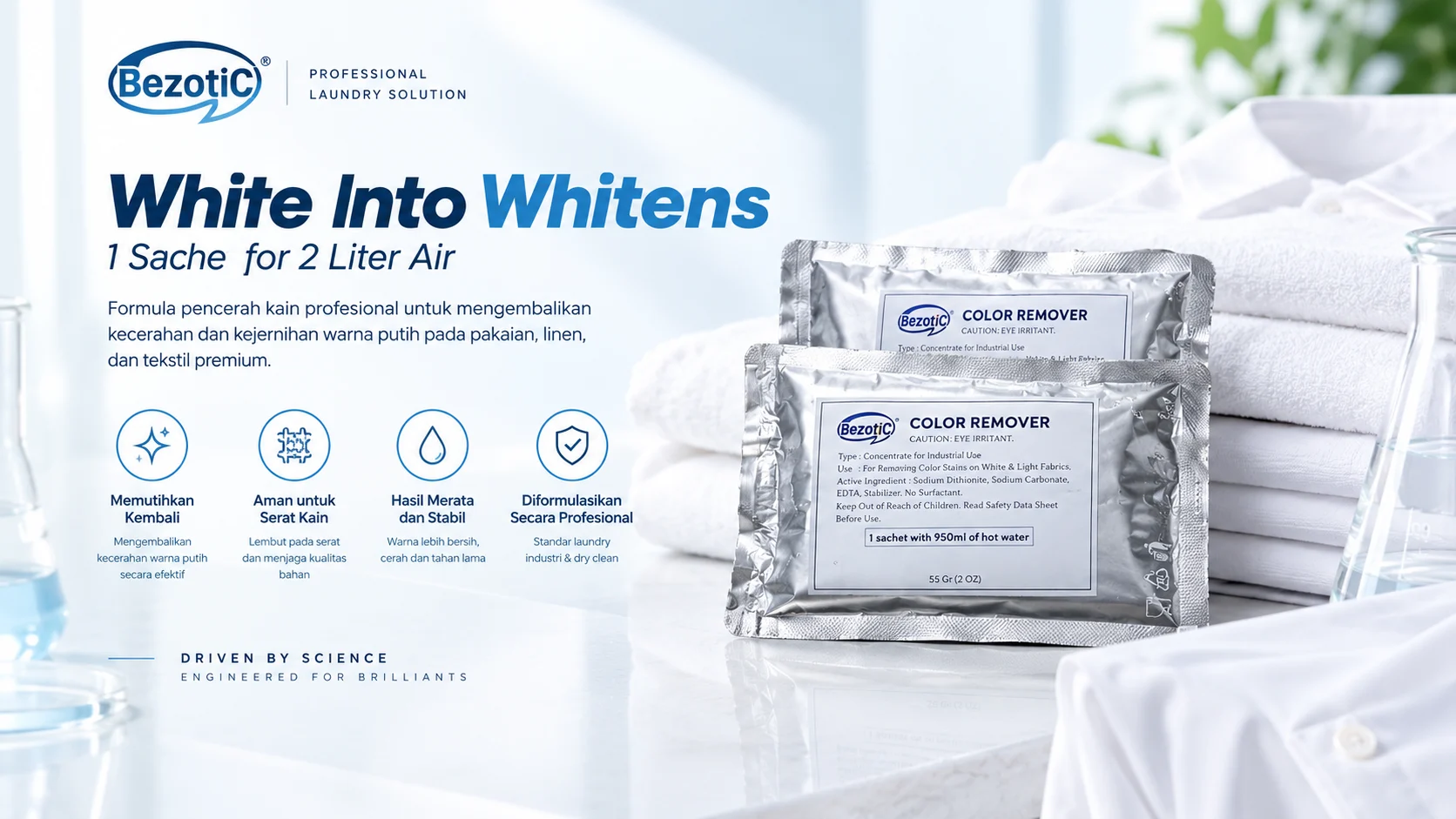
Introducing BeZotic Color Remover, a formula designed to help address specific color migration issues on white textiles and prepare the fabric for a more controlled re-dyeing process.
Color transfer, food stains, and discoloration caused by improper care require different identification and treatment methods.
White clothing mixed with colored clothing may experience discoloration. Any treatment must take into account the type of fiber and the fabric’s colorfastness.
Chlorine bleach is not suitable for all fabrics and can cause discoloration or damage to certain materials if used incorrectly.
Tea, juice, tomato sauce, and rust stains have different chemical properties. There is no single formula that automatically works for all types of stains.
BeZotic Color Remover is designed to help address specific cases of color transfer on textiles. The proper process begins with examining the source of the stain, identifying the fibers, and conducting compatibility tests.
When preparing to re-dye a fabric, removing the old dye can help prepare the material for the next step in the process. However, the final result still depends on the type of dye, the fabric’s composition, its initial condition, and the dyeing method used.
Learn about the main functions of BeZotic Color Remover before deciding whether this product is right for your textile needs.
Helps prevent color bleeding on white fabric when the type of dye and material are compatible with the product’s characteristics.
Supports fabric preparation for re-dyeing by reducing specific existing colors. The final color result still requires process testing.
Can be evaluated for specific types of stains. Rust, tea, juice, and sauce stains require treatment tailored to their respective characteristics.
An approach based on fiber type and color stability helps operators choose a more suitable process, rather than relying on a one-size-fits-all method for all fabrics.
Use in accordance with the product label, SDS, and the standards that apply specifically to the formulation being used.
Consult the textile care team regarding complex cases before treating the entire garment.
Follow the verified instructions on the packaging. Do not apply the same dosage or temperature to all types of fabric without testing.
Check the care label, fiber composition, type of stain, and colorfastness. Perform a compatibility test on an inconspicuous area before proceeding.
Use one 58-gram sachet with the amount of water explicitly specified on the official packaging for the specific application. The available dosage information specifies 950 ml of hot water or 2 liters of water; verify whether both options are permitted in the official instructions before use.
Apply only to materials that have been declared compatible. Follow the temperature, contact time, ventilation, personal protection, and usage instructions listed on the label and in the SDS.
Rinse according to the product instructions and fabric type. Evaluate the color, texture, and condition of the fibers before drying or dyeing.
Learn about Shella’s complementary products based on treatment type. These products do not have to be used together; the choice depends on your needs and material compatibility.
A bio-enzyme and active oxygen-based cleaner for specific cleaning needs, as directed in the formulation instructions.
Learn About BeZacT Powder →Recommended options for stain removal based on the formula’s characteristics. Check for compatibility before combining with other products.
Learn About OXI Hunt →A special formula for evaluating and treating ink stains on clothing or shoes based on the characteristics of the material.
Learn about BeZerO →Liquid detergent for daily use. Check the product specifications to ensure compatibility with your machine and fabrics.
Learn about BeZurE Matic →Products designed to support fabric hygiene care. Protection claims must be supported by test results and product instructions.
Learn About BeZaVita →Please provide the fabric type, color, source of the stain, and care history to help determine the appropriate approach.
Shella Team Consultation →Understand the nature of the stain, choose the appropriate cleaning method, and consider the care requirements of the material before deciding on a course of action.
Understand the causes of color transfer and the first steps to take when assessing white clothing that has discolored.
Read Shella's Blog Journal → Cleaning ChemistryUnderstand the differences in chemical cleaning approaches and why the choice of formula must be based on the characteristics of the fabric and the stain.
Explore Educational Articles → Technical SupportLearn about care considerations for linen, wool, rayon, suede, and mesh based on their materials and construction.
Explore the Documentation →The following information will help you understand the product's features and limitations before you begin the process.
BeZotic Color Remover is designed to help address specific color migration issues in textiles and can be evaluated for use in preparation for re-dyeing. Results depend on the type of dye, the fiber, and the condition of the material.
Separate garments affected by color bleeding, identify the fabric, check the care labels, and assess colorfastness. Use color-correcting products only if they are suitable for the fabric type and follow the official instructions. Avoid using bleach or hot water directly without first checking.
This product is marketed as a chlorine-free formula according to the provided specifications. Check the label and official formulation documentation to verify the actual composition. “Chlorine-free” does not mean it is safe for all types of fabric.
Linen and cotton may have different types of dyes and finishes. For both, it is still necessary to check the label, perform compatibility tests, and follow the official instructions. There is no universal guarantee that applies to all linen or cotton garments.
Wool is susceptible to changes caused by heat, pH, and certain mechanical treatments. Rayon can lose strength when wet, while ramie also has its own unique fiber characteristics and finishing properties. Do not use the same soaking method without first validating compatibility.
Effectiveness depends on the type of stain and the material. Rust stains may require a different chemical treatment than organic stains such as tea, juice, or tomato sauce. Do not treat Color Remover as a universal stain remover; identify the stain and choose the appropriate method.
Products can be treated to lighten certain existing colors before re-dyeing. However, color lightening may not be uniform or may alter the properties of the fibers. Conduct process tests and ensure the material is compatible with the dyeing system to be used.
ASTM D-4236 pertains to labeling regarding chronic health hazards in art materials. Reference to this standard does not automatically prove that a product is safe for all textiles or that it has laundry industry certification. Claims must be supported by the actual documentation available.
The information provided specifies one 58-gram sachet and 950 ml of hot water or 2 liters of water. Be sure to follow the correct volume, temperature, and usage instructions listed on the official label. Do not adjust the concentration based on the estimated intensity of the stain.
Do not mix BeZotic with chlorine, acids, or other chemicals unless official instructions specifically permit such a combination. Follow the SDS, use appropriate personal protective equipment, and ensure adequate ventilation.
Still unsure which method to use for bleaching white clothes or re-dyeing textiles? Check the fabric type, the condition of the stains, and the product instructions before you begin.
Consultation via WhatsApp →No warranty is provided regarding stain removal or color restoration without a material evaluation and verified terms of service.