
The Science Behind Washing the Mascot for Happy Puppy Karaoke Surabaya
In this case study, SHELLA was entrusted to handle the washing process for the Happie Pupies mascot, supporting the operational needs of Happy Puppy Karaoke Surabaya. The challenge was not only cleaning the white fur surface, but also controlling exposure to moisture, heat, and mechanical pressure on the mascot's construction.
Unlike flat textiles, a mascot has a three-dimensional shape and can contain several layers of material, including plush fabric, backing, foam support, stitched joints, and adhesive. The washing method must therefore consider the integrity of every part.
Information about the client's brand can be seen on the official Happy Puppy Karaoke website .
Summary: How Did SHELLA Wash the Happie Pupies Mascot?
SHELLA handled the washing stage for the Happie Pupies mascot for client Happy Puppy Karaoke Surabaya using a low-moisture foam cleaning approach. This method controls the amount of solution, the wetting area, and the contact time on a mascot construction that may consist of plush, backing, foam, stitching, adhesive, and decorative components.
The equipment and materials used in the documented process include BeZacT Powder, BeZacT OXI Hunt, steamer, horsehair brush, and air compressor. Their use was adapted to inspection and material compatibility. This article documents the washing stage only, not drying, grooming, finishing, restoration, or final quality control.
Many people assume that washing a mascot is simply a matter of spraying water, applying soap, brushing the fur, and then using a vacuum extractor. Visually, that method may look simple. Scientifically, however, that approach is not necessarily suitable for the construction of a commercial mascot.
A mascot head is not just a large piece of furry fabric. Its construction can involve plush fibres, textile backing, support foam, adhesive, stitching, and decorative components, each with different material characteristics.
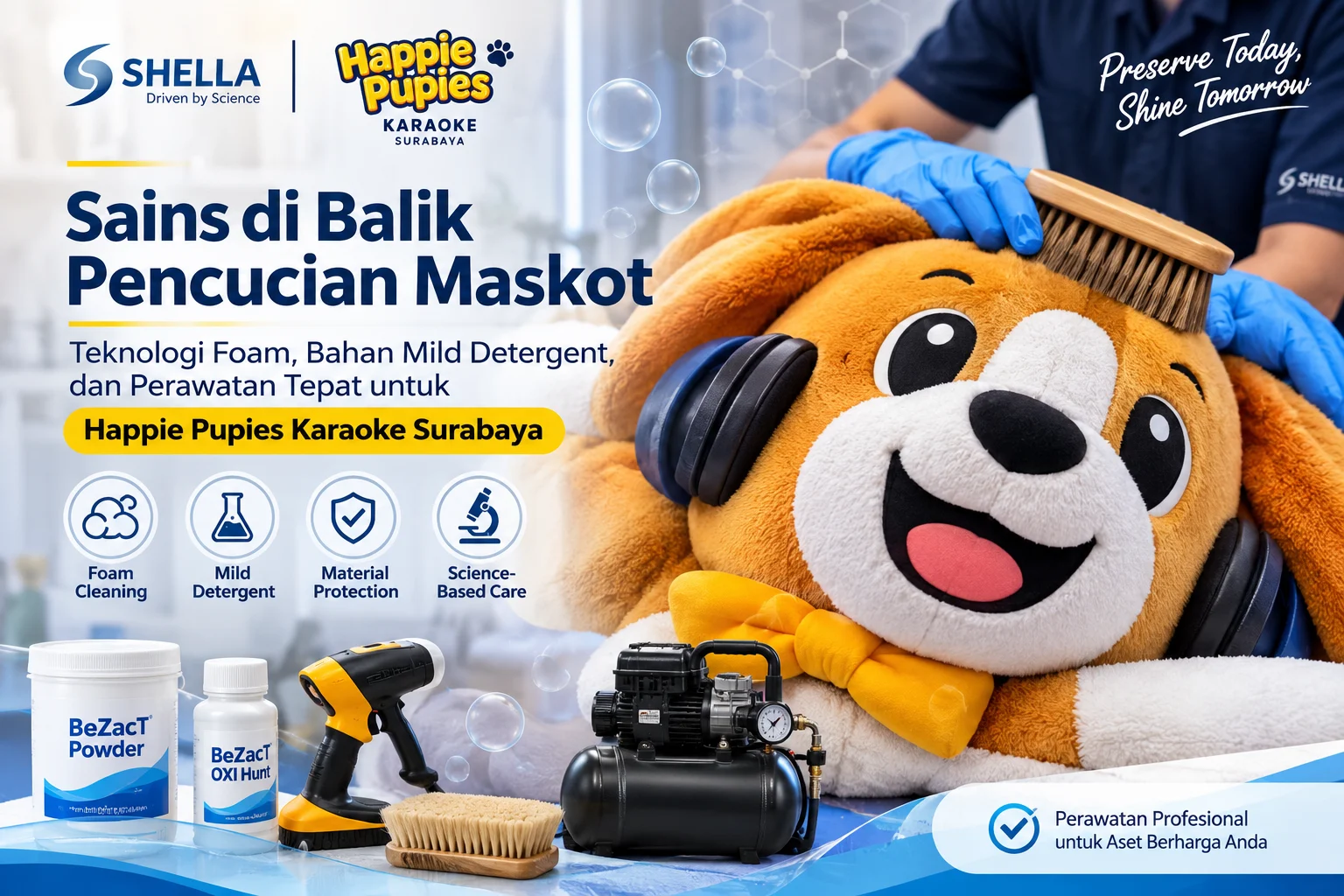
In the Happie Pupies case study, SHELLA documented the Washing and controlled cleaning stage. The focus is not on showing a fully restored mascot, but on explaining how the cleaning process must be controlled to minimise risk to the materials.
What Is Actually Being Cleaned from a Mascot?
Before choosing a washing method, the operator needs to understand that the furry surface is not the only material involved. On Happie Pupies, the face area shows white plush texture, plus eye, nose, muzzle, and mouth details that each need different treatment.
Understanding the five material zones
- Plush pile: Surface fibres that can trap dust and particles.
- Textile backing: The base layer to which the fibres or pile are attached.
- Decorative components: Eyes, nose, and decorative details that may have a coating or adhesive.
- Seams and joints: Joints that need protection from mechanical pressure and liquid penetration.
- Internal support: Support components that may have different absorption and drying characteristics.
Interfacial failure is a bond failure at the boundary between two materials. In mascot construction, this risk can be relevant to the bond between pile and backing, adhesive layers, or decorative components.
If bond weakening occurs, the impact can be loose fibres, peeling layers, or components losing stability. The level of risk depends on the actual materials and construction method.
Who Needs Professional Mascot Handling?
Commercial mascot care is relevant for companies, event organisers, entertainment centres, schools, institutions, shopping centres, and owners of mascot characters used repeatedly.
A mascot is both an operational asset and a visual representation of a brand. Its condition can affect user experience, character appearance, and continued usability.
The washing process should therefore consider textile characteristics, supporting components, decoration sensitivity, and the level of contamination.
Material assessment, controlled chemical application, mechanical stress management, and moisture management form the basis for decision-making during the cleaning process.
Where Do Dust and Contaminants Hide?
Contamination on a mascot does not always collect on the most visible surface. Particles can become trapped between fibres, while oily residue can increase dust adhesion on certain surfaces.
Four contamination mechanisms
- Mechanical entrapment: Particles physically trapped between fibres.
- Electrostatic attraction: Electrical charge interaction can help particles stick to the surface.
- Van der Waals interactions: Intermolecular forces can contribute to particle adhesion.
- Oily residue adhesion: Oil residue can form a layer that holds dust particles.
These four mechanisms explain why a single type of mechanical action is not always effective for all types of contamination. Dry particles, oily residue, and water-based stains require different strategies. Method selection must consider contaminant character as well as material tolerance to liquid, heat, and friction.
Handling the Head Area and Joints
A mascot head can have a foam frame, adhesive joints, stitching, and decorative details such as eyes and eyebrows. Because the actual material and adhesive types are not always known, handling is done selectively based on inspection and compatibility testing.
- Selective steaming: A steamer is only used when initial testing and material condition support it. Steam carries both heat and moisture; distance, duration, and application location must be controlled. There is no claim that the interior will definitely stay dry.
- Adhesive and detail protection: Avoid untested heat or solution exposure on adhesive joints, decorative components, and areas showing signs of weakness.
- Controlled soil handling: Lifted soil is handled with suitable tools and absorbent materials. This is not a claim that all internal moisture has been extracted.
When Does a Mascot Need Washing?
Washing timing should be determined through condition inspection, usage intensity, and the operating environment. Do not wait until colour change or odour becomes very obvious.
- After use at a high-intensity event.
- When there is a build-up of dust and dirt.
- When residue appears from contact with the environment or users.
- When inspection shows a need for localised or full cleaning.
- Before long-term storage, after material condition has been assessed and the drying process has been handled correctly.
Repeated use applies compression and pressure-release cycles to fibres and supporting materials. In certain foams, especially open-cell structures, repeated compression can change thickness and shape-recovery ability.
The extent of change depends on polymer type, cell structure, load magnitude, temperature, and compression duration.
Why Low-Moisture Foam Cleaning for Happie Pupies?
Commercial mascot washing is not just about removing dirt from the fabric surface. A mascot structure can consist of textile layers, foam, volume-forming panels, stitching, and parts joined with adhesive. Each component can respond differently to water, heat, friction, and cleaning agents.
In this case study, SHELLA handled the washing stage for the Happie Pupies mascot milik Happy Puppy Karaoke Surabaya . The focus of the method is controlling moisture during the washing process, especially in construction areas with joints and possible adhesive materials.
Low-Moisture Foam: Controlling Water, Not Eliminating It
Foam cleaning uses a cleaning solution formed into foam so application can be more targeted on the surface. Compared with wetting the entire object, this approach helps limit the amount of free liquid and the area exposed to moisture.
Foam still contains water. This technique must therefore not be called a dry or water-free process. Its advantage lies in controlling application, solution volume, contact time, and work area, not in assuming that moisture will not enter the material.
Why Does Moisture Need to Be Controlled?
Mild Detergent and Process Control
The cleaning approach uses cleaning agents with a controlled level of aggressiveness. In this process, BeZacT Powder is used as part of the washing system, while BeZacT OXI Hunt is considered as support for stain handling or brightening needs, depending on variant, material condition, and compatibility test results.
Material selection must not be based only on cleaning power. Concentration, contact time, application method, possible residue, and the material's ability to accept treatment must also be considered. Testing on a small, inconspicuous area is still required before wider application.
References and Service Context
The principles of surfactant selection and controlled textile cleaning can be explored further through the International Institute for Conservation (IIC) and the textile conservation guidance from the Canadian Conservation Institute . These references provide general scientific context, not certification or specific testing of this mascot's materials.
This specialty cleaning approach aligns with SHELLA's attention to material character and textile care needs. Also explore SHELLA dry cleaning services dan textile stain handling .
How SHELLA Approaches the Washing Process
Washing Happie Pupies was done with a step-by-step approach: identifying material condition, controlling solution application, performing measured agitation, then observing residual solution and surface condition at the washing stage. Handling after washing remains a separate stage.
Materials & Equipment
The equipment and materials that are part of this washing process include:
BeZacT Powder BeZacT OXI Hunt Steamer Horsehair Brush Air CompressorEach tool has a different function. Its use is determined by surface condition, contamination type, and material response during testing.
Initial Inspection & Material Assessment
Inspection starts with surface condition, furry areas, stitching, joints, volume-forming panels, and parts that may use adhesive. Areas that look fragile, deformed, or have open joints need to be identified before they come into contact with solution.
The goal is to define the washing area limits and avoid uniform treatment on materials with different characters.
Contamination Mapping & Spot Testing
Soil is observed by location, appearance, and surface character. Initial testing is done on a limited area to evaluate colour change, dye transfer, fibre response, and possible changes to the support layer.
This testing helps determine whether a particular area needs lighter application or should be kept away from wet treatment.
Controlled Cleaning Solution Preparation
BeZacT Powder is used as part of the cleaning system with a mild cleaning approach. BeZacT OXI Hunt is considered selectively for stain handling or brightening needs, depending on variant and compatibility test results.
The solution is prepared following established work procedures and internal dosages. Formula, concentration, and internal operational details are not shown in public documentation.
Low-Moisture Foam Application
Foam is applied in a targeted way to areas that need cleaning. This technique helps control the spread of free liquid and limits unnecessary wetting.
Application is done with attention to solution amount, area size, and contact time. Adhesive joint areas are not automatically treated the same as open textile surfaces.
In this process, a wet vacuum is not used as the main extraction method. Controlling application volume and handling residual solution therefore become an important part of the procedure.
Gentle Mechanical Agitation
Horsehair brush is used to help release dirt from the surface through controlled movements. Its relatively flexible bristle character supports detail work without relying on excessive pressure.
Agitation follows the direction and character of the material. Excessive pressure, rough movements, and pulling on fibres or joints are avoided to reduce mechanical load.
Selective Steamer Assistance
Steamer is used selectively when material condition allows and initial testing supports its use. Steam carries both heat energy and moisture, so distance, exposure duration, and application location need to be controlled.
Exposure is not directed randomly at adhesive joints, thermoplastic components, or heat-sensitive parts. A steamer is not a tool that automatically makes the process safer or guarantees stain release.
Airflow Assistance & Washing-Stage Observation
Air compressor with a clean, dry, oil-contamination-free air supply can be used in a controlled way to help lift loosened surface particles or residue.
Pressure and nozzle distance need to be adjusted. Airflow is not directed too close to seams or construction gaps so dirt and moisture are not pushed deeper.
At this stage, surface condition and the work area are observed again. Residue and moisture handling still need to be adapted to the mascot structure; using compressed air is not proof that all internal parts are dry.
Washing Is One Stage, Not the Final Chapter
This documentation focuses on the washing process for Happie Pupies for Happy Puppy Karaoke Surabaya. The visible washing stage is not a statement that the entire care series is complete.
After this stage, internal moisture condition, construction shape, joint areas, surface texture, and further handling needs still need to be evaluated. What will the mascot's condition be after all the next stages? That is part of the story not yet shown in this documentation.
SHELLA — Driven By Science. Engineered for Brilliants.
Washing Is Only One Part of Mascot Restoration
At this point, it is important to understand that the Washing process is not the same as a completed restoration process.
Liquid control, contaminant release, and mechanical detailing are part of the care series. After the washing stage, material condition still needs to be evaluated before determining the next handling.
Drying, internal moisture inspection, grooming, shape evaluation, and finishing are separate stages. Those stages cannot be considered complete based only on surface appearance after washing.
This is the important part of the Happie Pupies case study: understanding what happens during the cleaning process, why every action needs to be controlled, and how technical decisions can affect the next care stages.
Stay tuned for the next stage. The next documentation will discuss the follow-up process after Washing, focusing on handling material condition before the mascot is declared ready to use again.
Frequently Asked Questions About Mascot Washing
1. What is low-moisture foam cleaning?
A washing method that uses a foam-form solution and controls the amount of liquid, application area size, and contact time. Foam still contains water, so this method is not a dry or moisture-free process.
2. Why is a mascot not washed by soaking it right away?
A mascot can have a layered construction such as plush, backing, foam, stitching, adhesive, and decorative components. Soaking can increase liquid exposure on parts whose response is not yet known. The method must be determined after material inspection.
3. Does low-moisture cleaning guarantee the adhesive stays safe?
No. This method helps control liquid application, but does not guarantee all adhesive types are risk-free. Adhesive type, construction condition, heat, cleaning agents, and compatibility test results still need to be considered.
4. What are the functions of BeZacT Powder and BeZacT OXI Hunt?
BeZacT Powder is used as part of the cleaning system. BeZacT OXI Hunt is considered selectively for stain or brightening needs, depending on variant, material condition, and test results. Internal formulation and dosage details are not published.
5. Why use a horsehair brush?
A horsehair brush helps with controlled mechanical agitation. Pressure, movement direction, and brushing intensity need to be adjusted so as not to overload fibres or joints.
6. Is a steamer used on the entire mascot?
No. A steamer is used selectively when material condition and testing support it. Steam carries both heat and moisture, so application area, distance, and exposure duration need to be controlled.
7. Does an air compressor mean the inside of the mascot is already dry?
No. An air compressor with clean, dry, oil-free air and controlled pressure can help handle surface particles or residue. Its use is not proof that all internal parts are dry.
8. Does this article show the mascot has finished being restored?
No. This documentation focuses on the washing stage. Drying, internal moisture inspection, grooming, shape evaluation, finishing, and final quality control are separate stages that have not been declared complete here.
Specialty Textile Cleaning by SHELLA
SHELLA Premium Laundry & Dry Clean Surabaya documents a specialty textile washing approach with attention to material character, application control, and treatment limits.
Address: Jl. Nginden VI B No.1B, Nginden Jangkungan, Kec. Sukolilo, Surabaya, East Java 60118
WhatsApp: +62 813-2623-5096
Website: shellaweb.com
Professional Care for Commercial Textile Assets
Have a commercial mascot that needs special evaluation and handling? Consult on its material condition before deciding on a washing method.
Consult with SHELLAScientific note: The material explanations in this article are general principles of textile and polymer science. Identifying the actual composition, material durability, and internal condition of Happie Pupies requires direct material inspection. Visual results from the Washing Process are not proof that all internal components have been inspected or restored.
SHELLA Premium Laundry & Dry Clean Surabaya
Driven by Science · Engineered for Brilliants