


Beyond Standard Washing Powders
Laundry soil is rarely just one type of dirt. A single garment can contain oily soil, particulate dirt, protein residues, starch, pigment, body soil and discoloration at the same time.
That is why detergent performance is better understood as a system rather than a single cleaning ingredient. Surfactants help wet and lift soils, builders support washing conditions, enzymes target particular organic soils, oxygen-bleach systems address oxidizable discoloration, while polymers can assist with soil suspension and redeposition management.
BeZacT Powder is positioned around this multi-system formulation architecture. Rather than relying on one mechanism, its design combines several functional technologies intended to contribute to different parts of the washing process.
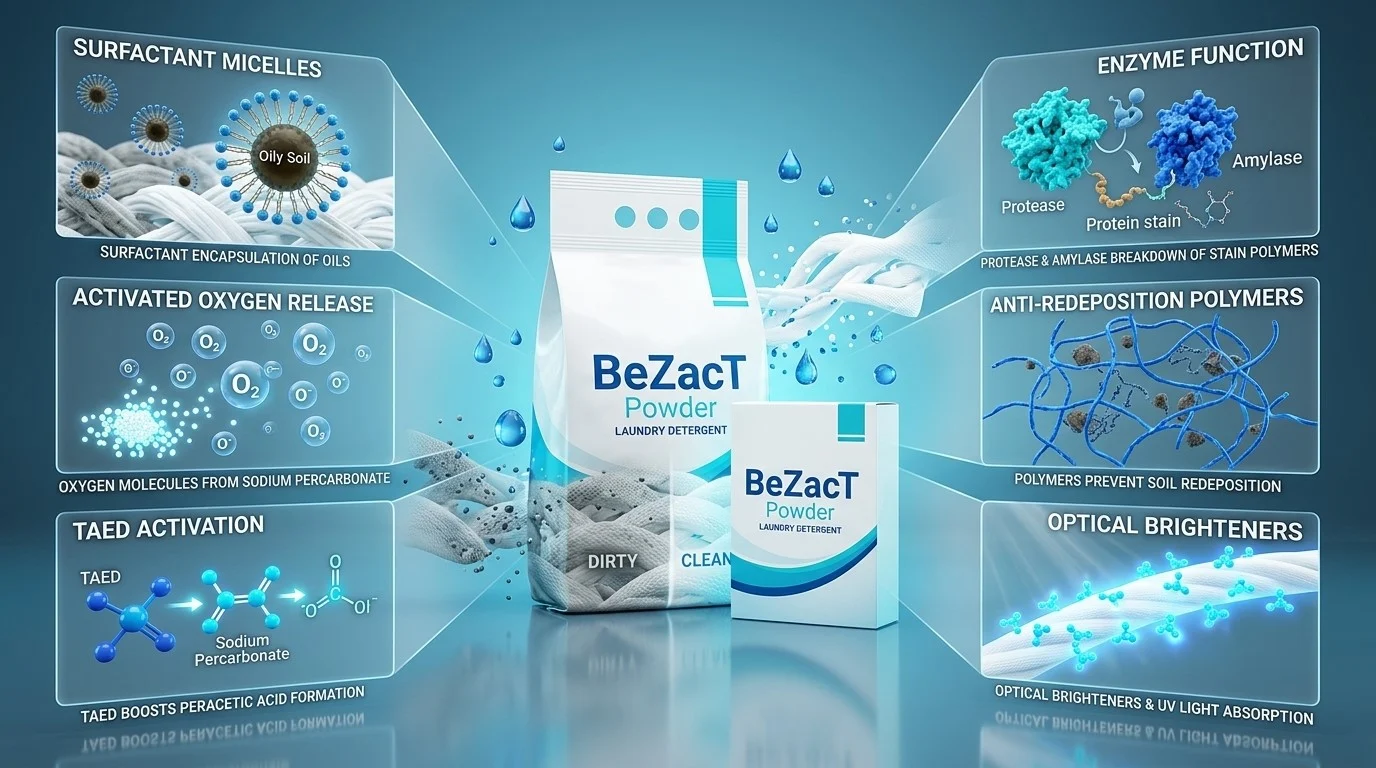
The Molecular Action of BeZacT
The cleaning process can be understood as several overlapping stages. Each stage addresses a different challenge encountered during laundering.
Wet & Penetrate
Surfactant systems reduce surface tension and help washing liquor contact the fabric and soil more effectively.
Break Down
Enzymatic technologies can target specific organic soils, such as protein and starch residues.
Oxidative Support
An oxygen-bleach system can contribute to the treatment of suitable discoloration and oxidizable organic residues.
Control Water
Builders help manage water hardness and washing alkalinity, supporting the overall detergent system.
Manage Soil
Polymeric technologies can help keep released soil suspended and reduce the tendency for soil to return to fabric.
Finish the Wash
The combined system is intended to deliver a more coordinated washing process rather than relying on one ingredient alone.
Inside the BeZacT Powder Architecture
A detergent formula is a system. Each functional group has a different job, and overall performance depends on their compatibility and balance.
Functional Ingredient Matrix
The following table explains the intended functional roles of the major technology groups discussed in the BeZacT formulation. Actual performance depends on formulation concentration, processing, dosage and washing conditions.
| Functional Group | Technology / Example | Primary Role |
|---|---|---|
| Surfactant System | Anionic + non-ionic surfactant technologies | Helps wet, loosen, emulsify and suspend different soil types. |
| Oxygen Bleach System | Sodium Percarbonate | Provides an oxygen-bleach source for suitable stain and discoloration treatment. |
| Bleach Activator | TAED | Supports activation of oxygen-bleach chemistry under appropriate washing conditions. |
| Enzymatic System | Protease + Amylase | Protease targets protein-based soils while amylase targets starch-based soils. |
| Builder System | Soda Ash / Sodium Citrate / Silicate technologies | Supports alkalinity and water-condition management. |
| Polymeric System | Soil-management polymers | Helps manage suspended soil and reduce redeposition during laundering. |
| Optical & Processing Support | Optical brightening and formulation-support technologies | Supports visual whiteness and the physical handling characteristics of the detergent. |
How the Systems Work Together
The interesting part of detergent formulation is not simply what each ingredient does individually. The objective is to make the different systems function together during the wash cycle.
1. Surfactants Prepare the Soil
Surfactants help water spread across fabric and interact with soils. Different surfactant types can contribute differently to particulate, oily and mixed soils.
2. Builders Support the Washing Environment
Water hardness can interfere with washing chemistry. Builder technologies help manage calcium and magnesium ions and contribute to an alkaline washing environment.
3. Enzymes Target Specific Organic Soil
Protease is associated with protein-based soils, while amylase is associated with starch-based soils. Enzymes are therefore complementary rather than universal stain removers.
4. Oxygen Chemistry Supports Discoloration Treatment
Sodium percarbonate provides an oxygen-bleach source. TAED is an activator technology commonly used to improve oxygen-bleach effectiveness under appropriate conditions.
5. Polymers Help Manage Released Soil
Cleaning is only part of the challenge. Released soil must remain in the washing liquor long enough to be removed rather than returning to the fabric. Soil-management polymers can contribute to this process.
BeZacT Powder Professional Dosing Calculator
This calculator is an educational formulation tool based on the example dosing model below. It is not a substitute for the actual BeZacT product label or professional laundry dosing instructions. Always validate dosage against the real product specification and washing machine conditions.
Formulation Architecture vs. Conventional Washing
A meaningful comparison should focus on formulation architecture and measurable washing conditions rather than simply counting ingredients. Different detergents are designed for different applications, and actual cleaning results can vary according to dosage, water hardness, temperature, mechanical action, cycle duration and fabric type.
Conventional Single-System Approach
- • May rely heavily on one dominant cleaning mechanism.
- • Performance can be strongly influenced by water hardness and wash conditions.
- • Some stain categories may require additional treatment.
- • Results depend heavily on correct dosage and wash parameters.
BeZacT Multi-System Architecture
- • Combines surfactant, builder, oxygen, enzyme and polymer technologies.
- • Different systems address different soil mechanisms.
- • TAED technology supports oxygen-bleach activation under suitable conditions.
- • Designed around coordinated formulation rather than ingredient count alone.
From Laundry Science to Professional Cleaning
The same scientific approach used to understand detergent formulation can also be applied to professional laundry operations: identify the fabric, identify the soil, select an appropriate cleaning system, control the washing conditions and inspect the result.
For professional laundry and dry-cleaning services in Surabaya, explore Shella Laundry & Dry Clean Surabaya Services .
For fast service requests, use the Shella Fast Order page.
Frequently Asked Questions
Why does BeZacT Powder use several ingredient systems?
Laundry soil is chemically diverse. Protein, starch, oily soil, particulate soil and discoloration do not necessarily respond to the same mechanism. A multi-system formulation allows different technologies to contribute to different cleaning tasks.
Does having more ingredients automatically make a detergent stronger?
No. Ingredient count alone does not prove cleaning performance. Concentration, ingredient quality, compatibility, enzyme activity, processing, dosage and washing conditions are all important.
What does protease do in laundry detergent?
Protease is an enzyme technology that targets protein-based soils. Examples include residues associated with blood, egg and certain food soils.
What does amylase do?
Amylase targets starch-based soils, making it complementary to protease and other detergent technologies.
Why combine sodium percarbonate and TAED?
Sodium percarbonate provides an oxygen-bleach source, while TAED is used as an oxygen-bleach activator technology. Their combination is commonly used to support oxygen-bleach performance under suitable washing conditions.
Can BeZacT Powder be used on every fabric?
Not automatically. Always follow the garment care label and the actual BeZacT product instructions. Oxygen-bleach and alkaline detergent systems may not be suitable for every fiber, dye or finish. When in doubt, test an inconspicuous area or consult a professional cleaner.
Does this calculator provide the official BeZacT dosage?
No. The calculator is an educational example based on the formula shown in this article. Official dosage should always follow the current BeZacT product specification, label instructions and the operating conditions of the washing process.
Engineered Cleaning Starts With the Right System
From everyday garments to premium fabric care, Shella combines material assessment, controlled cleaning processes and professional laundry technology.
Start Your Laundry ServiceWhatsApp: +62 813-2623-5096
Driven By Science • Engineered for Brilliants
Technical References & Further Reading
- ChemicalBook — TAED and laundry detergent technical information: ChemicalBook
- Sodium dodecyl sulfate background information: Wikipedia — Sodium Dodecyl Sulfate
- TAED product and technical information: Jebsen & Jessen Life Science
- Additional laundry and fabric-care education: Shella News & Care Guide