
How to Remove Fading and Stains from Delicate Dresses: BeZotiC Color Remover Instructions
A technical guide for addressing color transfer in Jacquard and Embossed dresses through material inspection, compatibility testing, and controlled color correction procedures.
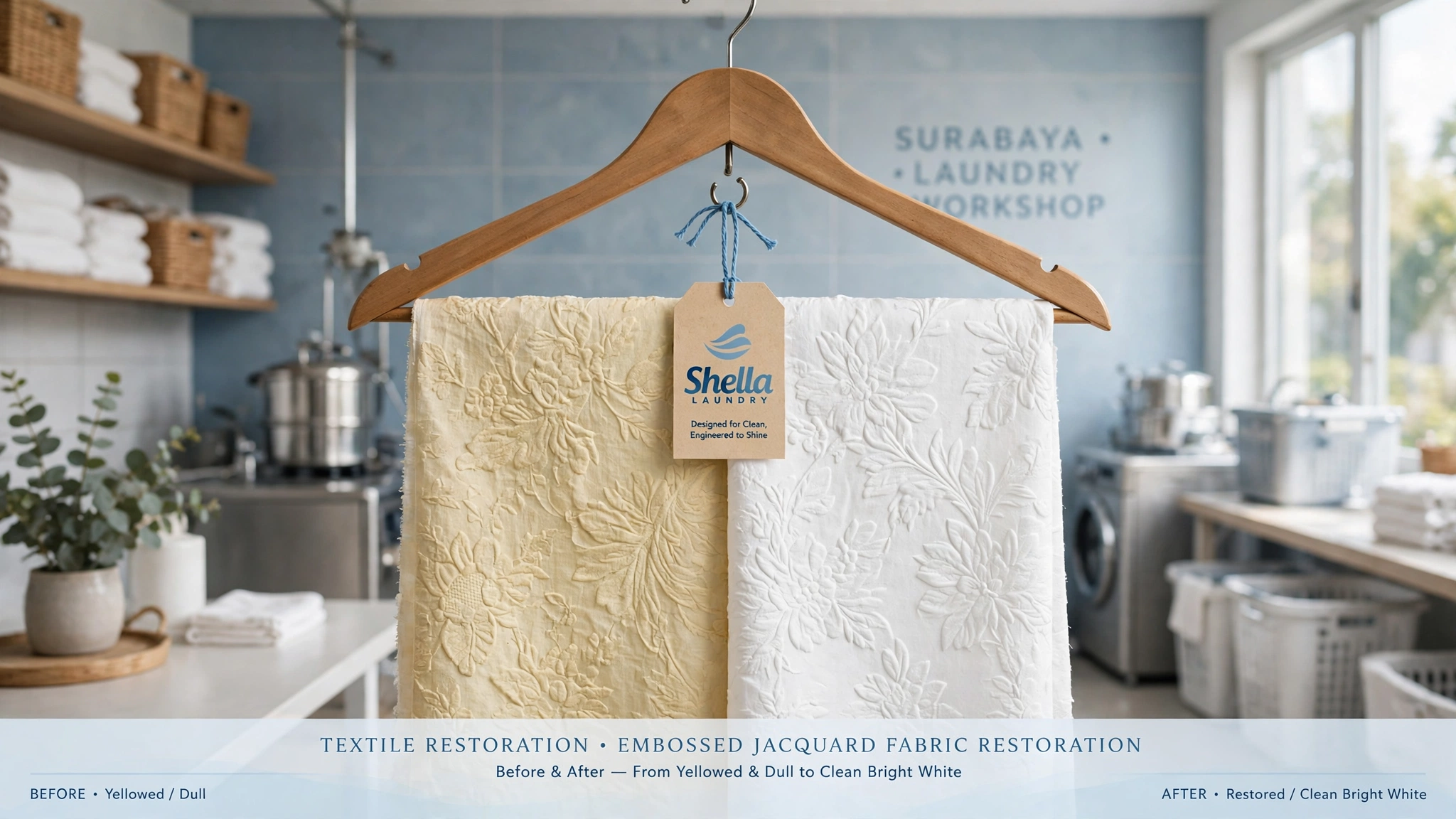
Understanding Fading Issues in Premium Dresses
What does it cover? This procedure addresses color transfer or color bleeding on dresses made of Jacquard and Emboss fabrics, including cases that require color evaluation prior to further cleaning. Where? Inspections and services are performed at the professional workshop of Shella Laundry & Dry Clean in Surabaya.
Who should do it? Operators who understand fiber identification, fabric construction, colorfastness, and the handling of sensitive materials. When is the procedure performed? The source of the stain, washing history, care label, and colorfastness of the dress were evaluated.
Why is an initial examination important? Color-removing agents can affect the original dye, decorative coatings, contrasting threads, and the finish structure. What is the approach? Through compatibility testing, selection of methods based on material response, controlled rinsing, and drying that preserves the dress’s shape.
What You Need
Tools and formulas needed to inspect and treat color-bleed stains on delicate dresses. Choose products based on process requirements and material compatibility.
BeZotiC Color Remover
Internal color correction formula for evaluating cases of dye migration. Use only after compatibility testing and technical approval.
Technical clarification: If consistent with the verified formulation sheet, use reducing agents, alkalinity regulators, and other agents. This formula is declared to be surfactant-free only if confirmed by documentation of the actual composition.
Note: Reducing agents may alter the fabric’s original color and do not guarantee stain removal without causing damage. Follow SDS, validated concentration, temperature, and contact time.
Use This ProductMicro Rinsing Basin
A clean rinsing basin with a smooth surface and sufficient space to help reduce friction and excessive creasing during the handling of the gown.
Use a special container that does not react with chemicals and is large enough to hold the material without pulling or twisting the fabric.
Use This ProductErgo-Garment Hanger
A hanger with a shoulder shape designed to support a dress during storage or drying, provided the construction and weight of the material allow it.
For heavy, embellished, or very delicate dresses, use a horizontal support or appropriate padding to prevent shoulder deformation.
Use This ProductStandard Operating Procedure: How to Remove Stains from Delicate Dresses
Not all color-fading stains require a reducing agent. First, determine whether the color change is due to dye transfer, instability of the original color, product residue, or damage to the finish. The choice of method should be based on the results of the examination, not merely on the type of stain that is visible.
Material Inspection & Identification of the Source of Fading
Check the care label, fiber composition, Jacquard or embossed construction, base color, decorative details, adhesive coating, and any stained areas. Document the initial condition using photos taken under consistent lighting.
- Determine whether the fabric is silk, polyester, a blend, or another type of fiber.
- Check for color consistency, contrasting threads, raised patterns, and accessories.
- Distinguish color transfer from oil stains, oxidation, or permanent discoloration.
- Perform a color test on a hidden area using the appropriate method.
- Record the test results before deciding whether to use a color correction formula.
Jacquard is a weaving technique, while embossing is a surface effect. Neither term automatically indicates the type of fiber or colorfastness. Be sure to identify the actual structure and finish before choosing a treatment.
Evaluation of Soaking with BeZotiC Color Remover
BeZotiC Color Remover is intended for specific cases that have been assessed as suitable for a reduction-based color correction approach. The agent may affect the dye, but it may also alter the original color, damage the decorative effect, or cause changes that are difficult to reverse.
Therefore, do not immediately soak the entire Jacquard or Emboss dress. Conduct a small-scale test using a validated procedure for the specific formula and material in question.
- Verification of SDS, composition, material compatibility, and workplace safety procedures.
- Set the concentration, temperature, and time parameters only in accordance with validated SOPs.
- Monitor changes in the base color, threads, ornamentation, and surface texture.
- Stop the process if any unwanted color changes or structural damage occur.
- Do not mix the formula with bleach, acids, or other chemicals without safety validation.
Note: This Is Not a Universal Formula
A reducing agent does not guarantee that faded stains will be removed without affecting the original color. Its effectiveness and compatibility must be verified through testing for specific formulations, fabrics, and dyes.
If a dress has a “dry-clean-only” label, special lining, easily detachable embellishments, or is of high value, prioritize professional evaluation and do not soak it without technical authorization.
Do not assume that the absence of surfactants is proof that the formula is safer for all fibers. The risk is determined by the overall composition, pH, processing conditions, dyes, and fabric construction.
Controlled Rinsing & Evaluation of Results
Once the color correction stage is deemed complete in accordance with the SOP, rinse the item using a method compatible with the materials and chemicals used. The goal is to remove process residues without applying excessive mechanical stress.
- Support the weight of the dress while moving it so that the fabric isn't pulled down by gravity.
- Avoid aggressively rubbing, twisting, or pressing the Jacquard and Embossed areas.
- Check for any color changes in the rinse water and evaluate color stability according to the procedure.
- Ensure that chemical residues are handled in accordance with product instructions and safety SOPs.
- Document the results before proceeding to the drying stage.
Use a container that is large enough and has a clean surface. Avoid forcing the dress into a small container, as tight folds can cause localized pressure, wrinkles, or distortion of the finish.
Structural Drying & Final Inspection
Dry the dress according to the care label and the fabric’s needs. The support should help maintain the dress’s shape without placing excessive strain on the shoulders, collar, seams, or embellishments.
- Use a drying method that has been determined to be compatible with the material.
- Avoid high temperatures, direct sunlight, and uncontrolled hot air currents.
- Choose a hanger with the right profile for lightweight dresses that are safe to hang.
- Use horizontal drying if the weight of the dress or its construction poses a risk of it losing its shape.
- Check the color, texture, shape, stitching, and decorative details again after it has dried.
Compare the final condition with the initial inspection photo. If the color transfer has decreased but the base color, texture, or finish has also changed, document this as a material change and communicate it transparently to the customer.
Fabric Care Alert: Jacquard, Embossed, Silk, and Suede
Jacquard, embossed, silk, and suede each have distinct characteristics. Jacquard refers to a method of creating woven patterns; embossed refers to surface texture; silk refers to the type of fiber; and suede refers to a type of leather surface or a material with a suede-like finish.
Do not use the same formula or soaking method for all of these categories. Leather suede, for example, generally requires a different approach than textile dresses. Test for compatibility, follow the care label instructions, and consult a specialist if there is a high risk of permanent damage.
Key principle: Preserving the integrity of the material is more important than forcing the stain to disappear in a single treatment.
Conclusion: The Management of Color Fading Must Be Based on Evaluation
To remove color bleeding from delicate dresses, it’s not enough to simply choose a color-removing product. The success of the treatment depends on identifying the cause of the stain, the stability of the dye, the fabric’s construction, the compatibility of the formula, and process control from start to finish.
At Shella Laundry & Dry Clean in Surabaya, a technical consultation can help determine whether a dress requires color correction, special cleaning, or conservative handling to minimize the risk of damage.
Dress Fitting Consultation