
Textile Care Guide · Sukolilo & Nginden, Surabaya
Why This Contoured Knit Pillow Should Not Be Machine-Washed: A Care Process Explained
A contoured pillow with a zoned knit cover is not the same as a pillow filled with loose fiber that can be removed and washed separately. When an item has a solid support core, its care needs to account for foam structure, knit texture, moisture, and thorough drying—not just surface appearance.
- Identify the pillow core and outer knit construction.
- Avoid soaking or machine washing unless the manufacturer specifically allows it.
- Controlled surface cleaning and extraction may be suitable when the material passes a spot test.
- Allow the pillow to dry completely before use.
Understanding the contoured knit pillow
The pillow shown has several knit-texture zones: a diagonal ribbed area, a finer ribbed section, and a perforated side panel. Its contour is designed to support the head and neck. The inner core appears to be a solid, yielding material that compresses and rebounds, rather than loose filling in separate removable compartments.
The exact core material cannot be confirmed from the video alone. Care should therefore be based on the manufacturer's label and a cautious material assessment, including a small-area test.
Why avoid a washing machine or dry-cleaning machine?
Machine-washing concerns
A dense foam core can retain moisture internally. Full immersion may make drying slow and difficult to verify. Drum movement, friction, spinning, and heat can also distort the core or damage knit loops, depending on the material and its condition.
Machine dry-cleaning concerns
Solvent exposure, tumbling, and warm machine drying are not suitable for every foam or knit combination. Certain materials may swell, deform, harden, or change surface texture. Without a care label confirming compatibility, machine dry-cleaning the entire pillow should not be assumed safe.
In this demonstration, cleaning is focused on the visibly soiled outer surface using foam, controlled brushing, and wet extraction. The intent is to limit liquid penetration into the core while lifting surface soil. The method still depends on an assessment and spot test.
Do not force the pillow apart. A tightly fitted solid core may not be designed to be removed. Pulling seams or forcing the core out can damage foam or stretch the knit cover.
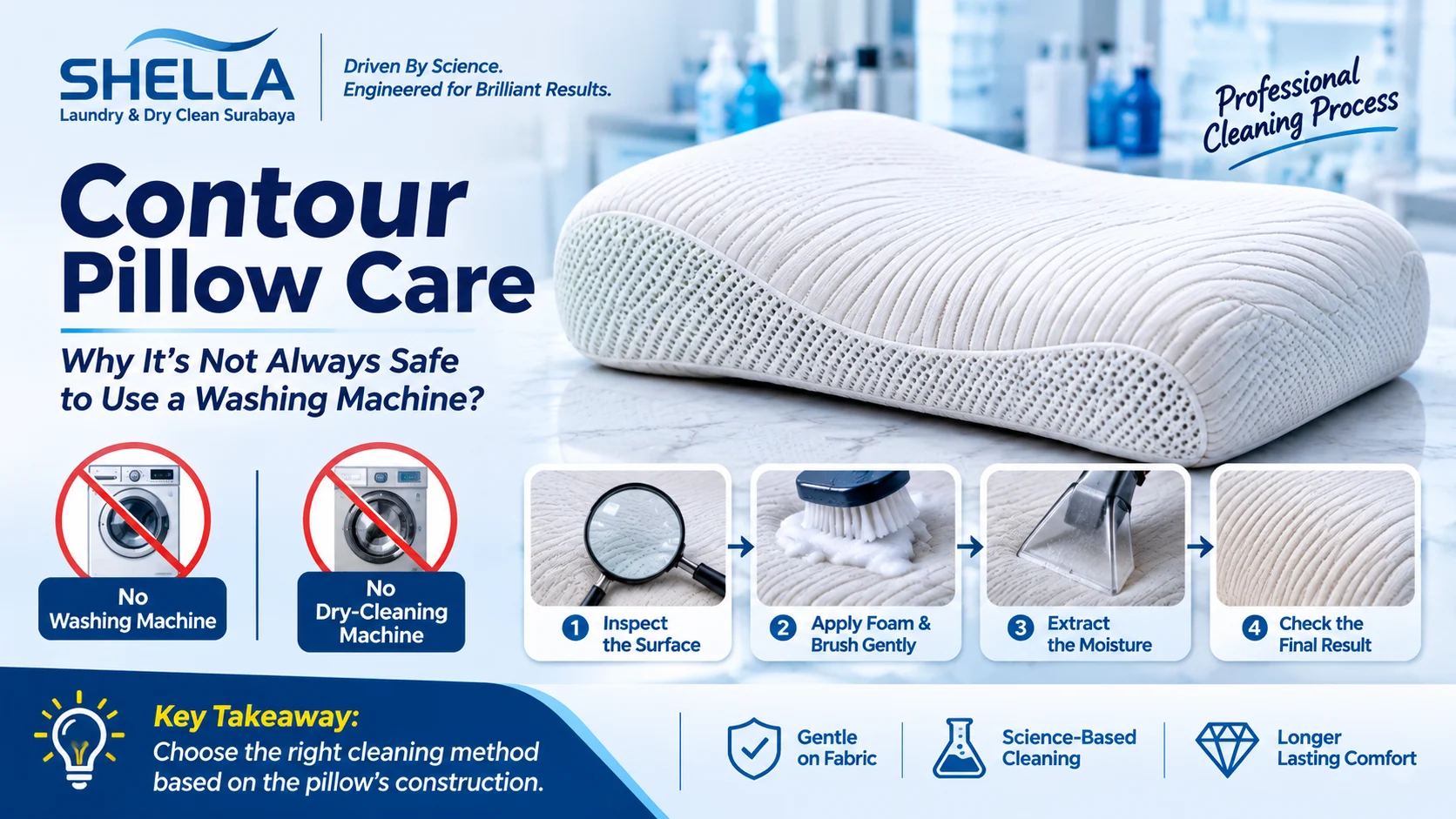
The cleaning stages shown in the video
The clip is edited quickly to keep the demonstration concise. In actual care, dwell time, brush pressure, liquid volume, and drying are adjusted according to the item's response and material checks.
Surface Inspection
Darkened areas and visible marks are checked along knit textures, folds, and joins. This helps identify where attention is needed so cleaner is not unnecessarily applied to unaffected areas.
Why: locate soil and plan targeted treatment.
Foam Application & Controlled Brushing
Foam is applied and worked over the surface with a brush. It helps loosen surface soil while brushing reaches the knit texture. Pressure and brush direction must be controlled to avoid snagging or fuzzing the knit loops.
Why: loosen surface soil without flooding the pillow core.
First Wet Extraction
An extraction wand is drawn over the pillow while the item is supported and gently compressed by hand. Suction helps remove loosened soil and moisture.
Why: lift residue and moisture after cleaning.
Targeted Cleaning
A small nozzle is directed toward specific areas that need additional attention. Working locally helps control moisture rather than wetting a larger area than necessary.
Why: treat localized marks or residue precisely.
Second Foam Pass & Detail Cleaning
Foam and brushing are repeated where further attention is needed. A flat detailing tool is carefully used around texture transitions and creases to avoid pulling, stretching, or cutting knit fibers.
Why: address soil around textured boundaries and creases.
Second Extraction Pass
The extraction wand passes over treated areas again, helping remove newly loosened soil and remaining foam.
Why: reduce cleaner residue and moisture before drying.
Side Panel Care & Final Inspection
The perforated side panel and edges receive attention, followed by a final surface inspection. Thorough drying is still required before reuse.
Why: check cleaning consistency and prepare for drying.
What to avoid when cleaning at home
- Do not soak the entire foam core or force it into a machine cycle.
- Avoid high heat or excessive direct heat.
- Do not scrub aggressively or use sharp tools to dig into knit fabric.
- Do not mix cleaners or use untested products on the fabric.
- Do not use the pillow if the core is still damp or smells of incomplete drying.
Drying and final inspection are part of the process
After cleaning, residual moisture needs to be reduced and the pillow dried in a well-ventilated area. A dense core can dry more slowly than the cover, so a dry-feeling outer fabric does not prove the inside is dry. Before reuse, check moisture, odor, texture, contour shape, and seam condition. Continue drying if the core still feels damp.
The video shows cleaning and extraction stages; it does not establish that the pillow core is completely dry by the end of the clip.
Pillow and textile care in Sukolilo & Nginden, Surabaya
Residents in Nginden Jangkungan, Klampis Ngasem, Keputih, Gebang Putih, Menur Pumpungan, and Gubeng can contact SHELLA about textile care and pickup options within the service area. Each item is assessed according to construction, care label, soil condition, and material risk.
Arrange a collection through our Surabaya pickup and delivery service, or ask about scheduling before sending an item. For local context, visit the official Surabaya City Government website or Institut Teknologi Sepuluh Nopember.
If you need laundry pickup in Surabaya or want to schedule an item assessment and collection, contact us to confirm area, timing, and estimate.
Frequently asked questions
Does SHELLA offer pickup in Sukolilo and Nginden?
Pickup and delivery are available in selected service areas. Contact our team to confirm your address, available time slot, and any minimum order requirements.
Are express service or car pickup options available?
Express service and vehicle pickup options may be available depending on service type, capacity, location, and daily schedule. Please confirm before booking.
How can I check the price and payment options?
Pricing is determined after the item type, condition, and treatment needs are assessed. QRIS, bank transfer, and cash may be accepted according to the confirmed service terms.
Where is SHELLA's Sukolilo workshop?
The workshop is at Jl. Nginden VI B No. 1B, Nginden Jangkungan, Sukolilo, Surabaya. Please contact us to confirm opening hours and arrange a visit.
Need help assessing your pillow or textile item?
Discuss the item's condition and care options with SHELLA Laundry & Dry Clean Surabaya. For Sukolilo & Nginden, confirm collection area, schedule, and estimate first.
Ask via WhatsApp